Table Of Content

The person continually off task would have a score of 30 (off task at every second interval for 5 minutes) and the person off task twice for a short time would have a score of 2 (off task only during 2 of the 10 second interval measures. Generally, in single subject research we count the number of times something occurs in a given time period and see if it occurs more or less often in that time period after implementing an intervention. For example, we might measure how many baskets someone makes while shooting for 2 minutes. We might play music while shooting, give encouragement while shooting, or video the person while shooting to see if our intervention influenced the number of shots made. After the 3 baseline measurements (3 sets of 2 minute shooting), we would measure several more times (sets of 2 minute shooting) after the intervention and plot the time points (number of baskets made in 2 minutes for each of the measured time points). Suppose a researcher wished to investigate the effect of praise on reducing disruptive behavior over many days.
Multiple-Baseline and Multiple-Probe Designs
As with each of the issues discussed in this section, there are advantages and disadvantages to the regression and non-regression methods for determining effect size for SSEDs. Nonregression methods involve simpler hand calculations, map on to visual inspection of the data, and are less biased in the presence of small numbers of observations (Scruggs & Mastropieri, 1998). Regression methods are less sensitive to outliers, control for trend in the data, and may be more sensitive to detecting treatment effects in slope and intercept (Gorman & Allison, 1996).
The benefits of single-subject research designs and multi-methodological approaches for neuroscience research
It is also unclear from this case study how typical or atypical Anna’s experience was. Regardless of the research design, the line graphs used to illustrate the data contain a set of common elements. In this example, we can see that the frequency of disruptions decreased once praise began. The baseline period is referred to as A and the intervention period is identified as B. Decisions regarding the effect of treatment are then made by comparing an individual’s performance during the treatment, B phase, and the no-treatment. “Anna O.” was the subject of a famous case study used by Freud to illustrate the principles of psychoanalysis.
I. Chapter 1: The Science of Psychology
The data from the baseline phase established that the participant did not respond correctly in the absence of the intervention. The data from the alternating treatments phase supported the effectiveness of the directed rehearsal and directed rehearsal plus positive reinforcement conditions compared with the control condition. They also supported the relative effectiveness of the directed rehearsal with reinforcement compared with directed rehearsal alone. Designs such as ABCABC and ABCBCA can be very useful when a researcher wants to examine the effects of two interventions. These designs provide strong internal validity evidence regarding the effectiveness of the interventions.
Interpretation of data
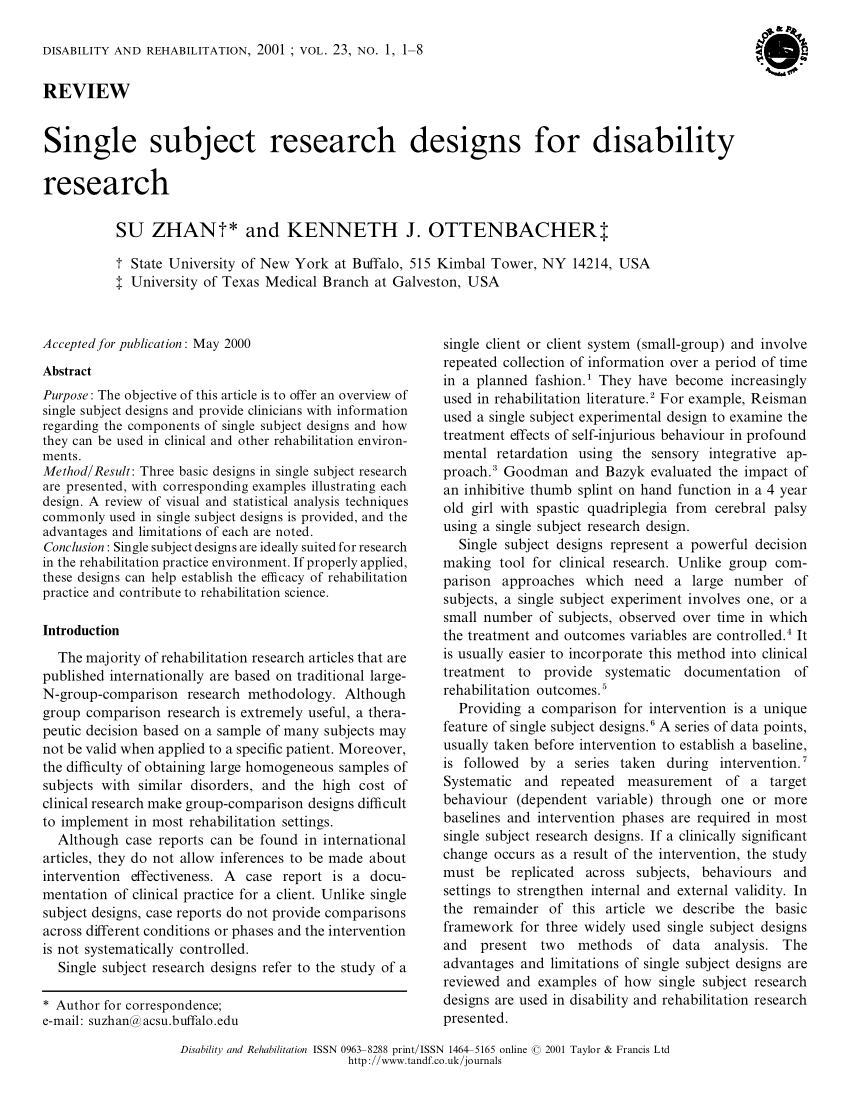
For example, a baseline might be established for the amount of time a child spends reading during his free time at school and during his free time at home. Then a treatment such as positive attention might be introduced first at school and later at home. Again, if the dependent variable changes after the treatment is introduced in each setting, then this gives the researcher confidence that the treatment is, in fact, responsible for the change. A second assumption of single-subject research is that it is important to discover causal relationships through the manipulation of an independent variable, the careful measurement of a dependent variable, and the control of extraneous variables.
The most basic single-subject research design is the reversal design, also called the ABA design. (Note that averaging across participants is less common.) Another approach is to compute the percentage of nonoverlapping data (PND) for each participant (Scruggs & Mastropieri, 2001)[4]. In visually inspecting their data, single-subject researchers take several factors into account. One of them is changes in the levelOne factor that is considered in the visual inspection of single-subject data.
Integrating electric field modeling and neuroimaging to explain inter-individual variability of tACS effects - Nature.com
Integrating electric field modeling and neuroimaging to explain inter-individual variability of tACS effects.
Posted: Thu, 28 Nov 2019 08:00:00 GMT [source]
Multiple-probe designs may not be appropriate for behaviors with significant variability because the intermittent probes may not provide sufficient data to demonstrate a functional relationship. If a stable pattern of responding is not clear during the baseline phase with probes, the continuous assessment of a multiple-baseline format may be necessary. Visual analysis of the results supports the effectiveness of the intervention in that there was an immediate change in unprompted question-asking with the implementation of the intervention for all three children, with no overlap between the baseline and intervention phases. As a result, this study provides strong evidence that the question-asking intervention results in increases in collateral question-asking.
In an alternating treatments design, two or more treatments are alternated relatively quickly on a regular schedule. This means plotting individual participants’ data, looking carefully at those plots, and making judgments about whether and to what extent the independent variable had an effect on the dependent variable. The beginning phase of an ABA design which acts as a kind of control condition in which the level of responding before any treatment is introduced. The plotting of individual participants’ data, examining the data, and making judgements about whether and to what extent the independent variable had an effect on the dependent variable. In an alternating treatments design, two or more treatments are alternated relatively quickly on a regular schedule. F. Skinner clarified many of the assumptions underlying single-subject research and refined many of its techniques (Skinner, 1938).
It can be especially telling when a trend changes directions—for example, when an unwanted behavior is increasing during baseline but then begins to decrease with the introduction of the treatment. A third factor is latencyOne factor that is considered in the visual inspection of single-subject data. The time between the change in conditions and the change in the dependent variable., which is the time it takes for the dependent variable to begin changing after a change in conditions. In general, if a change in the dependent variable begins shortly after a change in conditions, this suggests that the treatment was responsible. For example, a researcher might establish a baseline of studying behaviour for a disruptive student (A), then introduce a treatment involving positive attention from the teacher (B), and then switch to a treatment involving mild punishment for not studying (C).
Although an assumption of independence suggests that researchers should select conditions that are clearly dissimilar from one another, the conditions must be similar enough that the effects of the independent variable can be replicated across each of them. If the multiple baselines are conducted across participants, this means that all the participants must be comparable in their behaviors and other characteristics. If the multiple baselines are being conducted across behaviors, those behaviors must be similar in function, topography, and the effort required to produce them while remaining independent of one another. The withdrawal design is one option for answering research questions regarding the effects of a single intervention or independent variable.
Sometimes, a researcher may be interested in addressing several issues for one student or a single issue for several students. Once a baseline of behavior has been established (when a consistent pattern emerges with at least three data points), the intervention begins. The researcher continues to plot the frequency of behavior while implementing the intervention of praise. After you have implemented the randomized controlled trial, and then you want to implement the intervention in a more naturalistic setting, it becomes very difficult to do that in a randomized form or at the group level. So again, single-subject design lends itself to more practice-oriented implementation.
One argument against the exclusive reliance on visual inspection is that it is prone to Type 1 errors (inferring an effect when there is none), particularly if the effects are small to medium (Franklin, Gorman, Beasley, & Allison, 1996; Todman & Dugard, 2001). Evidence for experimental control is not always as compelling from a visual analysis perspective. In many cases, the clinical significance of behavior change between conditions is less clear and, therefore, is open to interpretation. RCTs do have many specific advantages related to understanding causal relations by addressing methodological issues that may compromise the internal validity of research studies.
This is necessary for the data from the experiment to yield statistically relevant results. This requires the time and resources to not only gather the participants, but to run trials of the experiment on all the subjects to gather all the data. An SSRD allows researchers to quickly design and run their study without having to find so many participants.
The resulting design is similar to a multiple-baseline, across-behaviors design with concurrent training for all behaviors. For example, Conaghan, Singh, Moe, Landrum, and Ellis (1992) assigned a different set of 10 phrases to each of three conditions (directed rehearsal, directed rehearsal plus positive reinforcement, and control). This strategy allowed the researchers to determine whether the acquisition of new signed phrases differed across the three conditions.
The multiple baselines can be for different participants, dependent variables, or settings. But if the dependent variable changes when the treatment is introduced for multiple participants—especially when the treatment is introduced at different times for the different participants—then it is unlikely to be a coincidence. The key to this design is that the treatment is introduced at a different time for each participant. One solution to these problems is to use a multiple-baseline design, which is represented in Figure 10.4. The dependent variable is the patient response, defined as a target behavior that is observable, quantifiable, and a valid indicator of treatment effectiveness.
Lang and colleagues (2011) used an ATD to examine the effects of language of instruction on correct responding and inappropriate behavior (tongue clicks) with a student with autism from a Spanish-speaking family. To ensure that the conditions were equivalent, all aspects of the teaching sessions except for the independent variable (language of instruction) were held constant. Specifically, the same teacher, materials, task demands, reinforcers, and reinforcer schedules were used in both the English and Spanish sessions.




No comments:
Post a Comment